
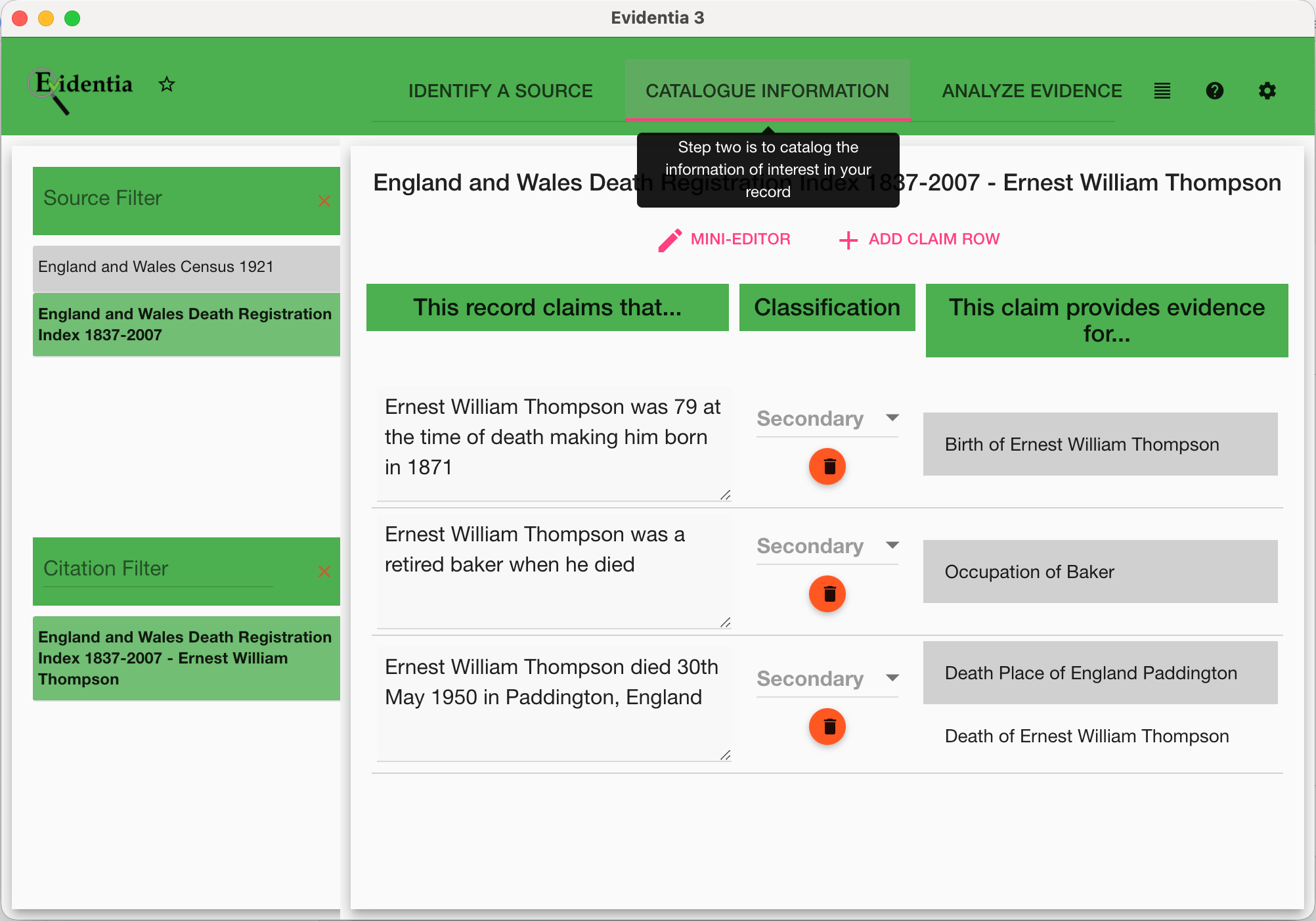
NOTE: When I wrote this I was using v3 of Evidentia but since then v3Plus has been released. This has a refreshed UI and seems to be a stepping stone to the next major release. All of what is in this post remains true for all versions.
Most family historians build their research around a tree. We collect names, attach records, add dates, and gradually extend branches backwards. But what happens when the tree stops growing?
That’s where a tool like Evidentia comes in.
I’ve been exploring Evidentia as a companion to my main tree software (in my case, MacFamilyTree) — not as a replacement, but as a way to think more clearly about evidence when facing a genuine brick wall.
Here’s what I’ve learned.
What Evidentia Actually Is
Evidentia is not a family tree program.
- It doesn’t draw pedigree charts
- It doesn’t search online databases
- It doesn’t generate pretty fan charts.
Instead, it’s an evidence analysis tool built around the principles of the Genealogical Proof Standard.
Rather than asking:
“Who are this person’s parents?”
Evidentia pushes you to ask:
“What does each piece of evidence actually claim?”
“How reliable is that claim?”
“Does it support, contradict, or fail to address my research question?”
It’s a shift from tree-first thinking to evidence-first thinking.
Where Evidentia Really Works
Evidentia shines in difficult cases — especially where records are incomplete, contradictory, or silent.
Typical scenarios include:
- Children entering workhouses or institutions
- Illegitimacy cases
- Conflicting census ages
- Multiple candidates with the same name
- Cases relying on indirect or negative evidence
Its real strength lies in:
1. Breaking big questions into smaller ones
Instead of tackling “Who were his parents?”, you create focused research questions such as:
- Under what circumstances did he enter the workhouse?
- What evidence exists for his mother before that date?
- Is there any direct or indirect evidence of a father?
This alone can clarify where the real problem lies.
2. Treating silence as evidence
Most tree software doesn’t handle negative evidence well. Evidentia does.
- No father named on a birth certificate? That’s evidence.
- No baptism found in expected parishes? That’s evidence.
- No family household in the census? That’s evidence.
When laid out clearly, patterns begin to emerge.
3. Testing competing hypotheses
Rather than settling too quickly on a convenient theory, Evidentia allows you to test alternatives:
- Mother deceased?
- Illegitimate birth?
- Family breakdown?
- Institutionalisation?
You can assess which hypothesis requires the fewest unsupported assumptions — a powerful way of dismantling brick walls.
4. Integrating DNA properly
Evidentia also provides a structured way to incorporate DNA evidence.
Instead of keeping DNA “separate”, you treat it like any other source:
- Extract the claims
- Classify them as direct, indirect, or negative
- Test them against documentary hypotheses
This prevents over-interpretation and keeps conclusions defensible.
Where Evidentia Doesn’t Help
It’s equally important to understand what Evidentia is not good at.
- It won’t find new records for you
- It won’t magically name unknown parents
- It won’t replace your main tree software
- It requires time and disciplined thinking.
If you’re happy with a broad outline tree and aren’t concerned about proof standards, it may feel like overkill.
It also introduces a different workflow. You must be comfortable slowing down and analysing rather than simply adding.
How It Fits into a Real Workflow
For me, the model looks like this:
- Use online databases to locate records
- Use my tree software, MacFamilyTree in my case, as the permanent repository
- Use Evidentia to analyse difficult research problems
- Feed well-reasoned conclusions back into the tree — without guesswork.
It becomes a research workbench rather than a display cabinet.
The Bottom Line
Evidentia won’t solve your brick walls for you.
But it will force you to think clearly enough that you understand:
- What you actually know
- What you only assume
- What evidence is missing
- Which hypotheses still stand up
And sometimes, clarity is what finally cracks the wall.
If you’re serious about improving the rigour of your research — particularly in complex cases involving institutional records, illegitimacy, or conflicting evidence — Evidentia is well worth exploring.
It doesn’t grow your tree faster.
It helps you grow it more honestly.
Evidentia is written and maintained by Ed Thompson, no relation, or maybe he is? Perhaps Evidentia could help me there!