
When we research our ancestors we tend to think of them in isolation along with the family group that they belong to. However, sometimes it can be instructive to look and see what was happening at that time in history. Doing this can help shape our understanding of what might have been affecting your ancestor at that time. It might be war, famine, regime change or some other event that might impact them.
In this post we take a look at a number of tools that you can use to help you find out what events went on during the life of any ancestor.
World History Timeline
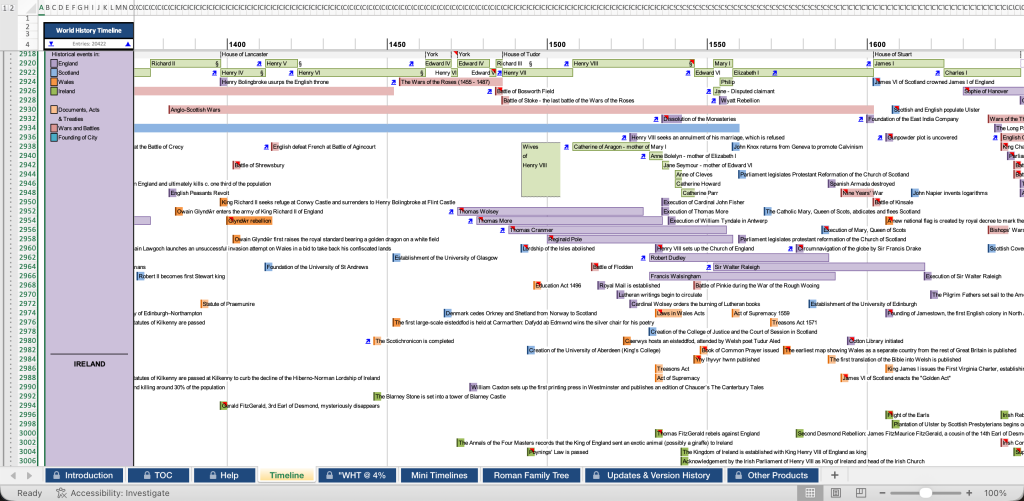
World History Timeline is, basically, a massive Excel spreadsheet with thousands of world events within it.
If you are familiar with Excel you will have less trouble finding your way around but for other and those less tech savvy it might well be a struggle. For example each time you open it you are presented with a scary message “This workbook contains macros. Do you want to disable macros before opening the file?” It might not be clear what to do. As it happens I have tried both enabling and disabling them and it seems to make no difference.
Once in you are presented with a “home screen” and a number of tabs including
- Table of Contents (labelled TOC)
- Help
- Timeline (the bit you are really interested in)
- WHT @4% (showing the whole thing at a tiny scale)
- Mini Timelines (a summary of the major points for a region)
- Roman Family Tree (not sure the relevance of this)
- Updates and Version History
- Other Products.
Using the TOC you can quickly get to the region or topic that you are interested in and then scroll across in time to find the period you require. Looking at period I was for my Great-grandfather who lived from 1873 to 1950 there are entries for such events as: The BBC is founded, King Edward VIII abdicates and the London Blitz. There is no mention, however, of the World Wars, perhaps because they span many regions?
There is absolutely no doubt that the World History Timeline is comprehensive, it claims to have over 20,000 entries but it is hard to navigate. If you can overcome that then it is a useful tool in the armoury.
| Pros | Cons |
| Comprehensive Includes lifetime updates | Hard to navigate Requires Excel/LibreOffice Only available on desktops and laptops Might be difficult for those less tech savvy |
World History Timeline, £16.75 (at time of writing)
Circa
I came across Cira recently when the developer posted details of it on social media, so I thought I would take a closer look.
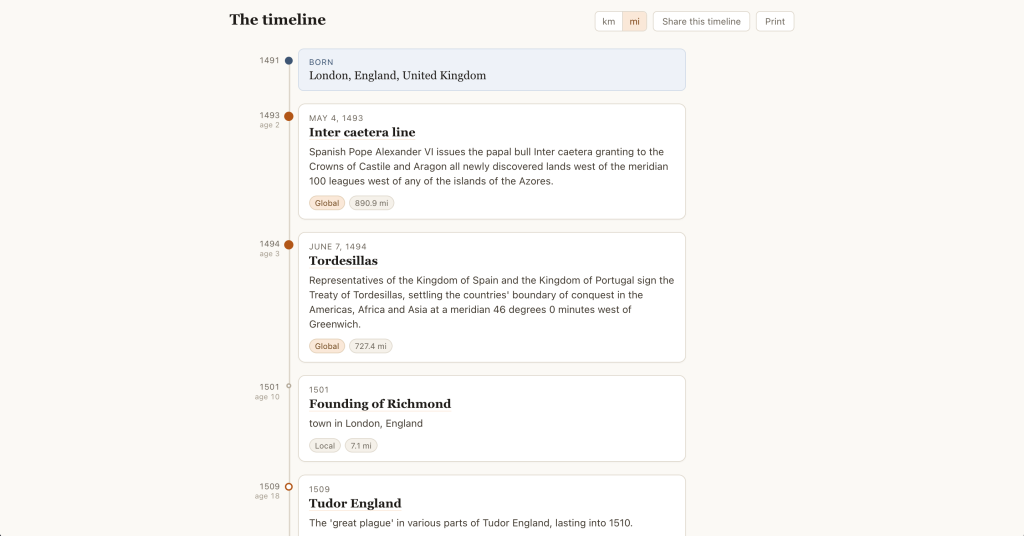
It is very straightforward to use – just add at least one life event, think birth, marriage, death, etc., with its date, and then click the Build the Timeline button. When I have used it, I included just birth and death details, but you seem to be able to add an almost limitless number.
It quickly comes back with a list of events that took place during the period you selected. The image above shows what it selected for the period King Henry VIII was alive.
I then tried for my Great-grandfather who lived from 1873 to 1950. The list of events included such things as “lacrosse at the 1908 Summer Olympics” and “Women’s World Chess Championship 1927” along with more substantial events such as “Turbojet engine” and “Treaty of Versailles”. Each event is linked to the appropriate Wikipedia entry so you can investigate in more detail.
What Circa made no reference to was the First and Second World Wars, which would have had a far greater impact on my great-grandfather’s life than, say, “lacrosse at the 1908 Summer Olympics”. This is a huge omission limiting the value of Circa.
I like the simplicity of Circa, but right now, with so many important events missing, it is hard to recommend it.
| Pros | Cons |
| Web-based Free | Misses many events, such as world wars |
Circa, Free
Charles Booth Poverty Map
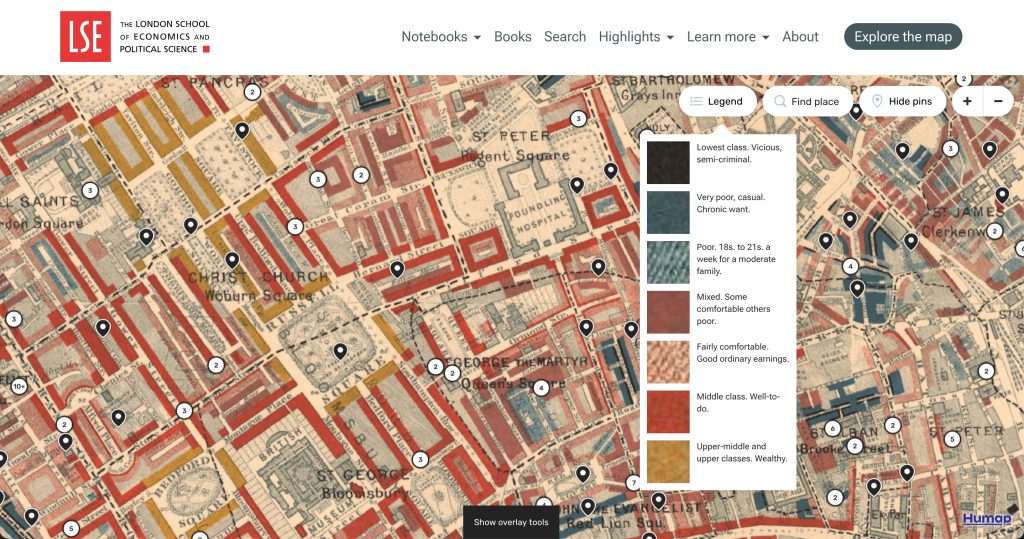
This one is slightly different to the two above in that it doesn’t give you a timeline, instead it shows you the level of poverty in late 19th century London.
Charles Booth was a social researcher and reformer. From 1886 to 1903, Booth carried out a survey on the life and labour of London’s poorest inhabitants and created poverty maps to illustrate the conditions of the lives of these people.
These maps have been made available and searchable by The London School of Economics. You can search for a property by address and see what the poverty level was for that street. This will give you and idea of the socioeconomic level of your ancestor.
What is fascinating is just how close areas of deep poverty were to well-to-do areas.
Using this information can give you an insight into what life might have been like for your London ancestor.
| Pros | Cons |
| Web-based Free | Only covers London in late 19th century |
Charles Booth Poverty Map, Free
Conclusions
There are some interesting tools available to support you as you try to understand what was going on around the time your ancestors were alive. None I found were perfect but act as a good starting point.
What do you think about these kinds of tools? Do you know of any others? Let us know in the comments.