
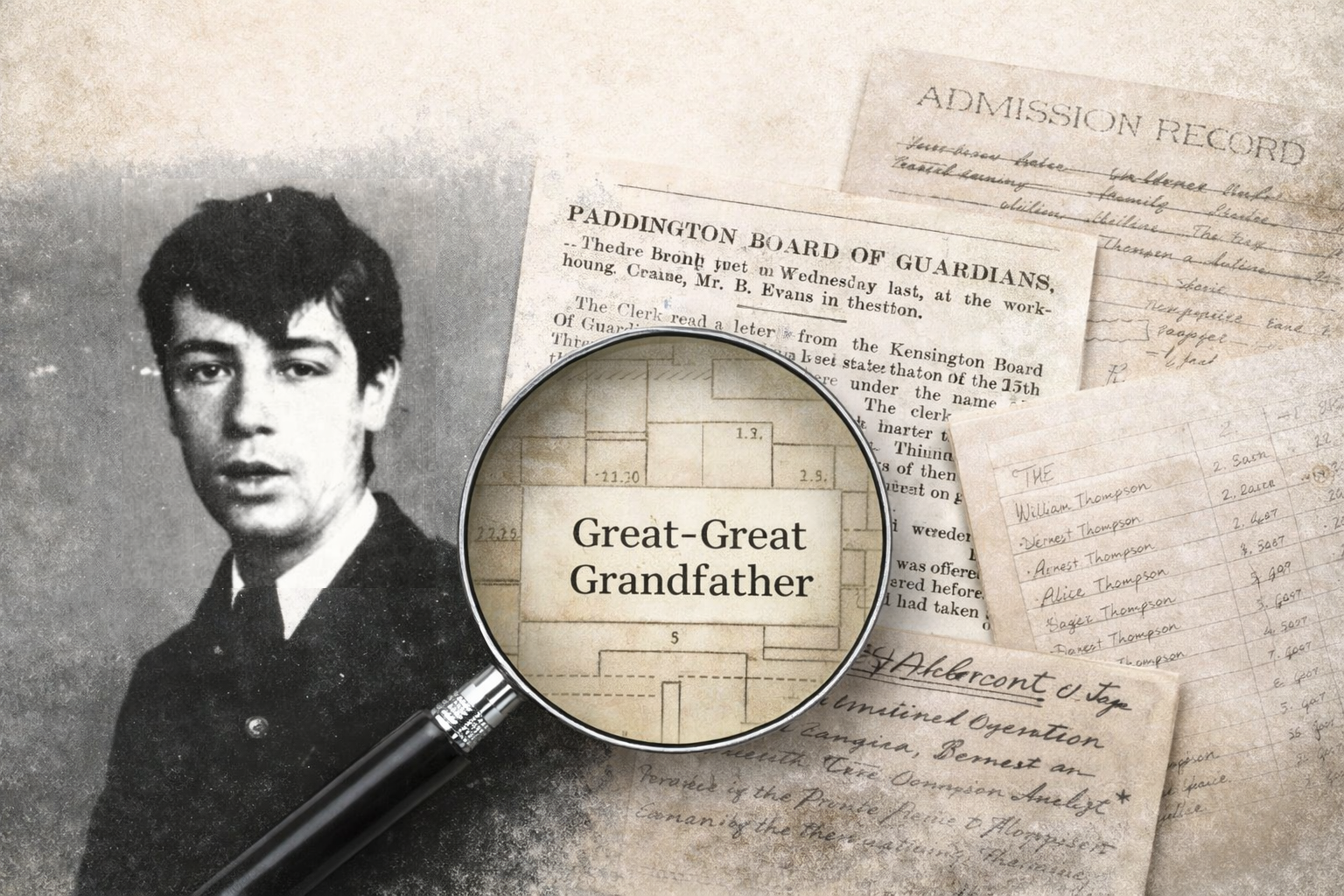
I run a u3a Family History group and our topic last month was “AI and Genealogy” where we looked at the current AI landscape and how it might be able to help you in your family history. This was summerised as follows:
- Transcribing parish registers and wills
- Summarising research notes
- Identifying possible record matches
- Drafting readable family histories
- Enhancing old photos
This went well, but it made me wonder if I could use AI to help me break down a brick wall I’ve had since 1988.
Ernest William Thompson
I know a lot about my great-grandfather Ernest William Thompson (forthwith EWT for brevity) from the age of four but nothing of him before that age, including the names of his parents. This is because at four he entered the Paddington Workhouse and wouldn’t leave the workouse system again until he was 15.
I know about the illnesses he had, how he was sent away to convalesce, the names of his three brothers and their fates, and his not-so-successful apprenticeship as a baker. But what I don’t know are the names of his parents.
ChatGPT Enters the Chat
Following on from the u3a session, I decided that I should make use of AI to help me with a way forward. To be clear, I wasn’t expecting AI to present me with the names of EWT’s parents, but I was hoping that it might be able to give me some direction. Therefore, I went back to the entry records for when EWT and his siblings entered the West London District Schools. Looking again, I found a couple of columns headed “Orphan” and “Desertion,” which led me to ask this question:
Looking at the entry record for the west London district school which some of my ancestors went to in 1875 there are two columns one labelled “orphan” and the other “Desertion”. There is a tick in the desertion column for each. Does this mean that they had been abandoned by their parents?
This led to some interesting responses:
In the context of a District School admission register in 1875, a tick in the “Desertion” column almost always means parental desertion, not that the child had deserted anything themselves.
What “Desertion” usually meant
Under the Poor Law system, desertion meant a parent (often the father, but sometimes the mother) had:
- Left the family without providing financial support
- Disappeared or absconded
- Refused to maintain wife and children
This made the children chargeable to the Poor Law Union and eligible for admission to the district school.
Good stuff, but how to proceed? ChatGPT had a suggestion for that too.
If you like, I can draft a step-by-step research plan specifically for the Thompsons in Paddington 1871–1881, showing which records to consult first and in what order to reconstruct the parents’ situation and the boys’ early lives. This would give you a concrete roadmap rather than chasing bits randomly.
The Power of Newspapers
Rather than paste the whole of that research plan here, I want to concentrate just on a single point:
Step 6: Newspapers & Local Records
Goal: Pick up traces of parents, desertion proceedings, or employment placements.
- Search for:
- “Thompson” + “Paddington” + “desertion” or “pauper child”
- Local newspapers often reported cases of parental desertion, bastardy, or children being committed to schools.
- Court & petty sessions records may exist for the father if anyone pursued maintenance or prosecution.
It just so happened that FindMyPast was providing free access to its newspaper archive that weekend, so I started there using the search prompts ChatGPT had provided.
Almost immediately I found the following:
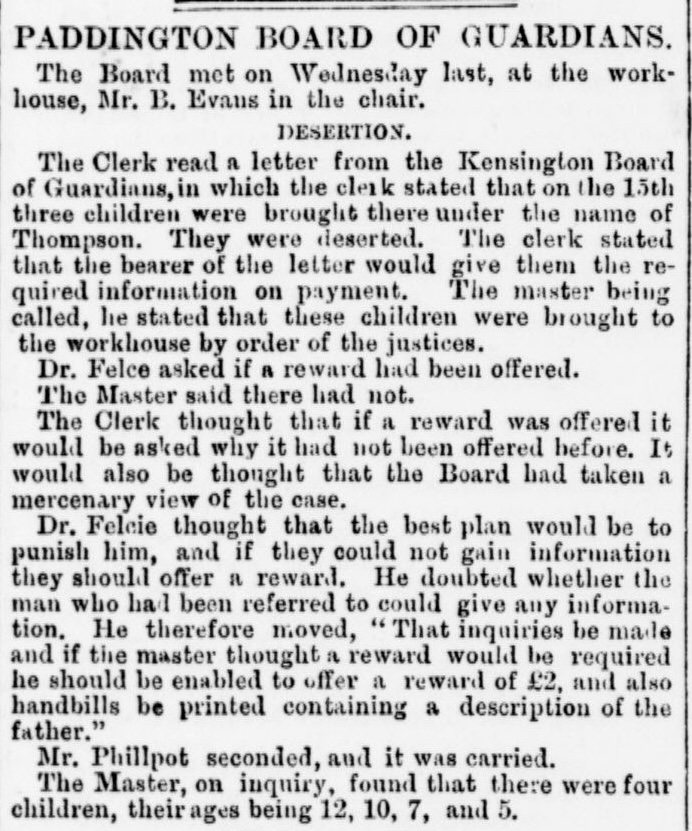
From this it will not be obvious that this is my family but I could be reasonably sure due to the following:
- The article states that “three children were brought there under the name of Thompson”; obviously, the surname is the same and the the workhouse entry records show three taken in
- Later the article states that “The Master, on inquiry, found that there were four children” which would be because EWT entered a week later than his siblings
- Finally, “their ages being 12, 10, 7, and 5” exactly matches the ages of the four children taken in.
This was an exellent start so I delved further and found this nugget:
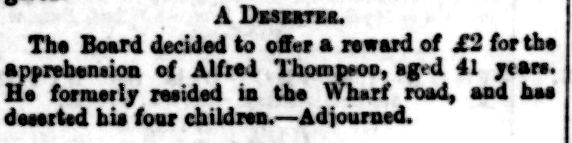
I now had a name, approximate age and where he had been living which was an awful lot more than I’d had for the previous 40 years!
Finally, I continued my search and found this:
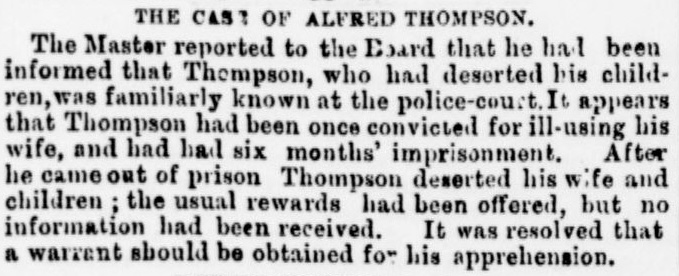
It appears that my great-great-grandfather was not a great guy. Abused his wife, for which he went to prison, and then on release abandoned his wife and children and disappeared, leaving the children to the workhouse system and who knows what happened to his wife.
In Conclusion
AI didn’t do any of the work for me but did help me understand better what I was looking at, putting it in some sort of context, and where to look and how to search. With a few nudges in the right direction it has moved me on considerably.
The next step is to go and view some of the records in person, such as the Paddington Board of Guardian Minutes which aren’t online.
I haven’t included all of the chat but, if you are interested, you can read it all in full here.
One response to “Breaking Down a Brickwall with AI: How I found my Great-Great Grandfather”
[…] my great-grandfather Ernest William Thompson. Through a combination of online research and help from an AI chatbot I had made a lot of […]