
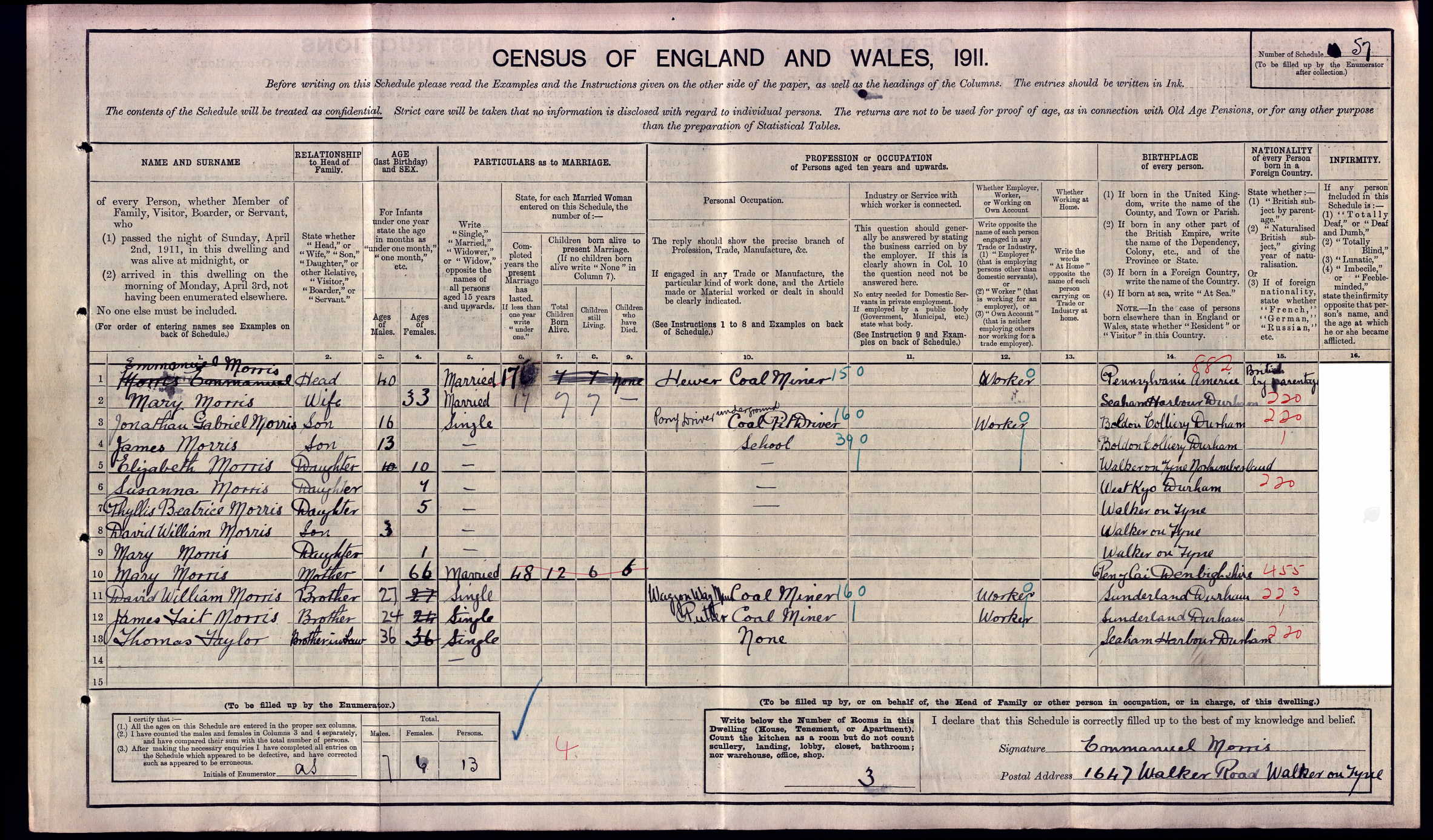
For anyone researching their family history, the census is one of the most valuable record sets available. Taken every ten years, it allows us to trace families over time, watch children grow up, see occupations change, and follow movements around the country.
Here we explore how to make the most of UK census records — including the invaluable 1939 Register.
A Brief History of the UK Census
A census has been taken in England, Wales, Scotland and Ireland every ten years since 1801. However, the early censuses (1801–1831) are of limited use to genealogists because they mainly contain statistical summaries rather than named individuals.
For family history research, the key censuses are:
- 1841–1911 – Fully available and widely used
- 1921 – Available (currently via Findmypast)
- 1931 – Destroyed in a fire in 1942
- 1941 – Not taken due to the Second World War
And then there is the hugely important 1939 Register, which acts as a substitute for the missing 1941 census.
What Makes the Census So Valuable?
From 1841 onwards, censuses list individuals by name. From 1851, the detail becomes much richer and includes:
- Full names
- Exact ages
- Relationships within the household
- Occupations
- Birthplaces
- Addresses
This allows us to:
- Build timelines for individuals
- Identify parents and siblings
- Track migration between towns and counties
- See changes in occupation and social status
- Spot extended family living nearby
The census provides not just names and dates, but context — it helps us understand how our ancestors lived.
Important Differences Between Census Years
Not all censuses are the same, and knowing their quirks is important.
1841 Census
- Ages of adults were often rounded down to the nearest five years.
- Birthplaces were recorded simply as “Yes” or “No” for whether someone was born in the same county.
1851–1901 Censuses
- Much more detail, including precise birthplaces and clearer relationships.
1911 Census
- The first census completed by the householders themselves.
- You can often see your ancestor’s own handwriting.
- Includes information on years married and number of children born (and how many had died).
The 1939 Register – A Vital Resource
With the 1931 census destroyed and no census taken in 1941, the 1939 Register fills an important gap.
Compiled at the outbreak of the Second World War, it was used to issue identity cards and ration books. It later became the foundation of the NHS register.
The 1939 Register includes:
- Full date of birth
- Address
- Occupation
- Marital status
It is especially useful because:
- It gives exact birth dates (rare in earlier censuses).
- It covers the wartime generation.
- Later name changes (for example through marriage) are sometimes added in the margins.
Some entries remain closed if the person is likely still living, but many can be opened if a death has been recorded.
For many families, the 1939 Register is the only record placing relatives between 1921 and the early post-war period.
Tips for Using Census Records Effectively
- Always check the original image.
Transcriptions can contain errors. - Be flexible with spelling.
Names were often written phonetically. - Use occupations to confirm identity.
This is especially helpful with common names. - Look at neighbours.
Families often lived near relatives. - Follow the household over time.
A single census is useful — a sequence of censuses tells a story.
A Simple Research Exercise
One powerful technique is to choose a single ancestor and trace them through as many censuses as possible.
For example:
- Where were they living in 1861?
- Did they move by 1871?
- Did their occupation change?
- How many children were born between each census?
- Did elderly parents move into the household?
By comparing entries side by side, patterns begin to emerge. The census becomes less a list of names and more a narrative of a life.
Final Thoughts
The census is often the backbone of British family history research. It provides structure, continuity, and context. When combined with civil registration records, parish registers, military records and newspapers, it allows us to reconstruct not just family trees — but family stories.
And with the addition of the 1939 Register, we are fortunate to have a bridge across one of the most disrupted periods in modern British history.
If you haven’t yet traced one of your ancestors across multiple censuses, why not start today? You may be surprised at what you discover.