
If you spend any time researching family history in England and Wales, you very quickly come across a key date: 1837.
It’s one of those dividing lines that separates two very different worlds of record keeping — and understanding it can make your research far more effective.
Before 1837: Parish Registers
Prior to 1 July 1837, there was no national system for recording births, marriages and deaths. Instead, these events were recorded by the Church of England in parish registers.
These registers date back to 1538, when Thomas Cromwell ordered every parish to keep records of baptisms, marriages and burials. In theory this was systematic; in practice, it could be anything but.
What you’ll typically find:
- Baptisms (not births): usually the child’s name, date of baptism, and father’s name. Sometimes the mother’s name, occasionally an occupation.
- Marriages: names of bride and groom; after 1754, much more detail thanks to Hardwicke’s Marriage Act.
- Burials: often just a name and date. Age was sometimes included, but not always.
Registers vary enormously in clarity and detail. Some are beautifully written and thorough. Others are sparse, damaged, or missing entirely.
Two important improvements before civil registration:
- 1754 – Hardwicke’s Marriage Act
Standardised Anglican marriage entries and required formal procedures (banns or licence), except for Quakers and Jews. - 1812 – Rose’s Act
Introduced pre-printed register books for baptisms and burials, greatly improving consistency.
But even by the 1820s and 1830s, there was still no guarantee that a birth or death had been recorded at all.
1837: The Beginning of Civil Registration
Everything changed on 1 July 1837, when civil registration began in England and Wales.
The government established a national system to record:
- Births
- Marriages
- Deaths
These records were collected centrally by what became the General Register Office (GRO).
For genealogists, this is transformative.
From this point onwards:
- Registration was intended to be universal (although compliance wasn’t perfect at first).
- Records followed a standardised format.
- Certificates contained far more genealogical detail.
What Civil Certificates Give You
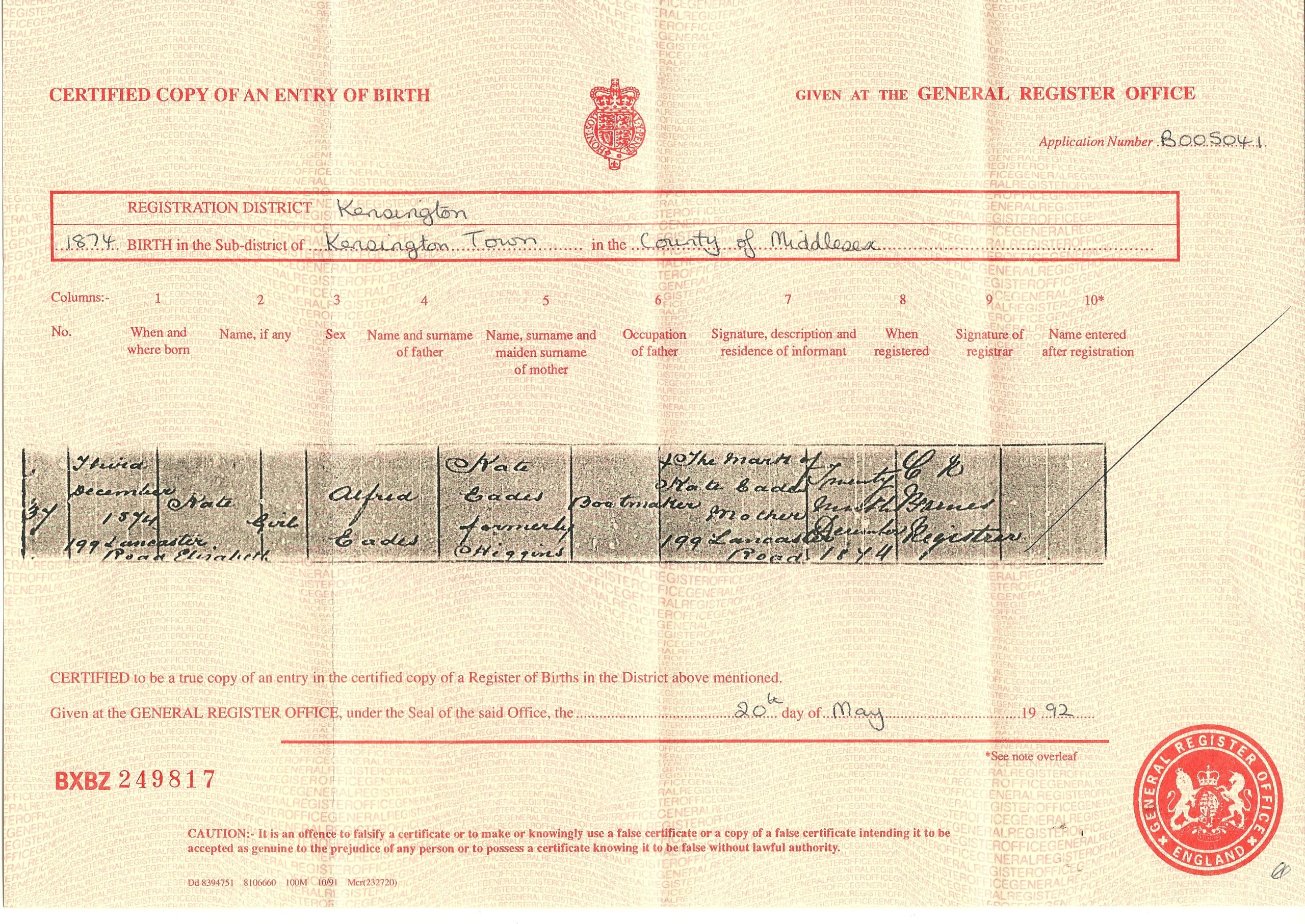
A civil birth certificate includes:
- Exact date and place of birth
- Father’s name and occupation
- Mother’s name, including maiden name
A marriage certificate includes:
- Ages (or “full age”)
- Occupations
- Addresses
- Fathers’ names and occupations
- Witnesses
A death certificate includes:
- Age at death
- Cause of death
- Informant’s name and address
That last detail — the informant — is often overlooked but can be a crucial clue to family relationships.
Why 1837 Is a Research Turning Point
In practical terms, 1837 gives us:
- Greater reliability
You’re no longer dependent solely on whether a family used the Church of England. - Better evidence for relationships
A marriage certificate naming fathers can help confirm the correct line in a common-surname puzzle. - A solid foundation for working backwards
It’s often easiest to anchor a family tree securely in the late 19th century using civil certificates, then move back into parish records with confidence.
When I’m tackling a brick wall, I nearly always ask myself:
Have I fully exploited the civil registration evidence?
Beyond England and Wales
It’s also worth remembering that:
- Scotland began civil registration in 1855 — and Scottish certificates are often even more detailed.
- Ireland began civil registration of non-Catholic marriages in 1845, and of births, deaths and all marriages in 1864.
Each jurisdiction has its own quirks, but the same principle applies: civil registration represents a step change in record reliability.
A Simple Rule of Thumb
If your ancestor was born, married or died:
- After 1837 in England or Wales — start with civil registration.
- Before 1837 — expect to rely heavily on parish registers and supplementary sources.
Understanding that dividing line doesn’t just make research easier — it helps you interpret what you’re looking at.
And in family history, interpretation is everything.